💭 Impressions
I read this when I was 20, and it completely changed how I think about money and time. It's the reason I got into entrepreneurship and started building my own projects.
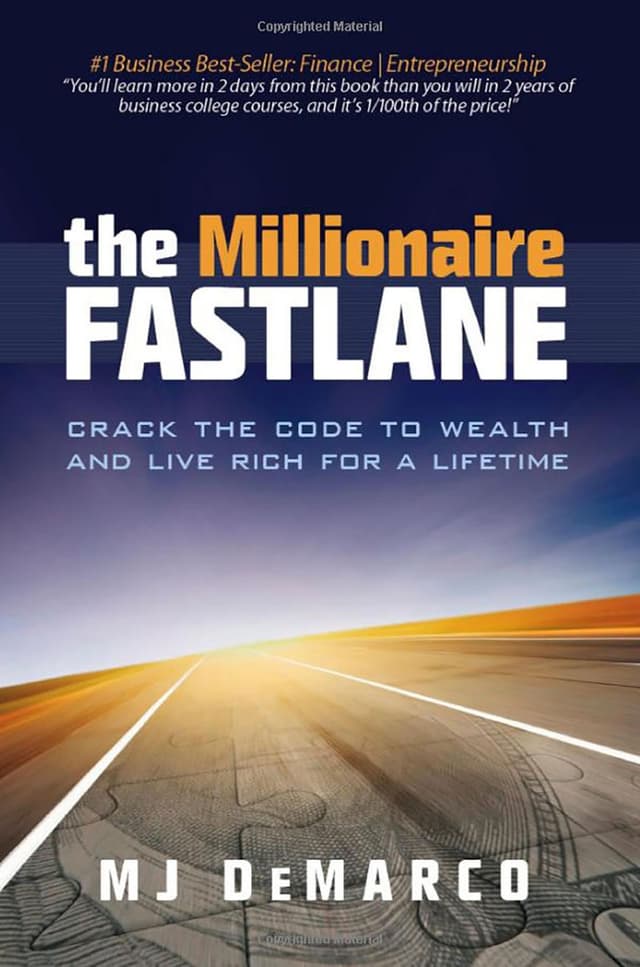
This book is about rejecting the slow, linear path of saving and investing over decades and instead building a scalable business system that creates wealth fast. Through leverage, control, and reinvestment, you can achieve financial freedom on your own timeline, not when you reach retirement.
Quick Warning
While the knowledge is useful I'm not a fan of how he speaks down on the employed as if they are inferior to entrepreneurs. DeMarco clearly got lucky during the dot-com era and is at times extremely tone-deaf to people's circumstances. If this were written by anyone else, I reckon I would've given it a higher rating. So while I recommend this book, you'll need to get past the occasionally abrasive language.
🎯 Who Should Read It?
I'd recommend this to anyone considering launching a business or wanting to build a system that scales rather than trading time for money indefinitely.
It's also worth reading if you're currently following the traditional advice: work a 9-5, save, invest passively, and wait for retirement. For a perspective on whether that's actually the fastest path to the life you want.
🍀 How the Book Helped / Changed Me
-
Mentality Shift: As my first ever entrepreneurship book, it got me thinking more like a builder than an employee. I'd worked a job since I was 16, and it had never crossed my mind that I could use my own skills to make something and sell it. At 19, I became a software engineering apprentice, but I never considered that instead of only building software for my employer, I could build products of my own.
-
Picking the Right Business: I always thought you simply had to start on an idea and things would figure themselves out — whether that's following your passion, say playing guitar, and trying to build a tutoring company off the back of it. I now realise certain businesses let you reach financial freedom far quicker because they meet specific criteria. Take time, for example — systems where you put in the hard work once, like writing a book and earning royalties, can keep generating income long after the work is done.
-
Only One Idea Has to Work: Building a business isn't about how much money I can possibly accumulate before the age of 30. It's a process of trial and error to get one idea right that could change my life forever. I can build business after business, fail, and learn from each mistake. It might take me 3–5 years, or even longer, but the one idea that finally takes off could be the thing that sets me up for financial freedom. Allowing me to live life on my own terms, not controlled by what an employer needs me to be or what my family expects me to be.
✍️ My Top 3 Quotes
“I’m a great believer in luck, and I find the harder I work, the more I have of it.
“Stop thinking about business in terms of your selfish desires, whether it’s money, dreams or “do what you love.” Instead, chase needs, problems, pain points, service deficiencies, and emotions.
“All events of wealth are precluded by process, a backstory of trial, risk, hard work, and sacrifice. If you try to skip process, you’ll never experience events.
📋 Summary
Slowlane vs Fastlane
At the start, MJ DeMarco uses logic and math to describe the 'Slowlane,' a financially mediocre plan where you live poor young and then die rich old. Trading time for money typically sounds like this:
“Go to university → get good grades → graduate → get a good job → save 20% of your paycheck → invest in the stock market, preferably in a low-cost index fund → max out your pension contributions → keep a frugal budget… then someday, when you are 65 years old or better, 55 years old if you are super miserly, you will be rich.
He spends a lot of the first third of the book basically convincing you why you should become an entrepreneur. How old methods of creating wealth, like a salary & stock market returns, aren't going to get you to your goals quickly.
But once that part is over, he moves on to use business as a 'Fastlane' vehicle to arrive at two destinations:
-
Complete passivity with a money system
-
An exit strategy where you liquidate huge high-value assets for millions of pounds
Thus, achieving financial freedom within 5-10 years.
The 'CENTS' Framework
To judge whether a business idea actually qualifies as a Fastlane vehicle, he introduces a framework called CENTS (Control, Entry, Need, Time, Scale):
-
Control: You run the whole system, not an employer or platform that can pull the rug out from under you.
-
Entry: Businesses that anyone can easily start in minutes, like drop-shipping or affiliate marketing, are not worth it. The higher the barrier to entry, the more likely you are to make money, as there's less competition. Example: There are only a few chip foundries, like TSMC, in the world, as it's a tough business. Therefore, these companies make hundreds of billions of pounds.
-
Need: Stop chasing money and start chasing market needs. Solve a real problem people will pay for, not something that you selfishly want.
-
Time: Build a company that can eventually run without you directly working on it—do the work once, then sell it over and over to generate income even when you're not actively involved. Examples:
- Digital products: Books, YT videos, websites/coding templates
- Software / internet systems: SaaS, video games, apps
- Renting out stuff: Real estate, cars, tools, etc.
- Physical products: Skincare brand, clothing line
-
Scale: If you can sell to millions, you can make millions. Does your business only affect your local community or the world?
Putting It Into Practice
“There’s a profound difference between interest and commitment. Interest reads a book; commitment applies the book 50 times.
A local service business might satisfy Need but fail to Scale. An online business might satisfy Entry but fail Control if it's fully dependent on someone else's platform. Like an ecommerce site that ONLY exists on Shopify or Amazon. Since Amazon could suspend the account or launch a competing product at any time, then I'd be out of business
I now run every idea I have through these five filters. They only take a few minutes, but they save me loads of time by showing which ideas are actually worth pursuing, as opposed to which ones just feel exciting.
If you enjoyed this, check out more of my book reviews: